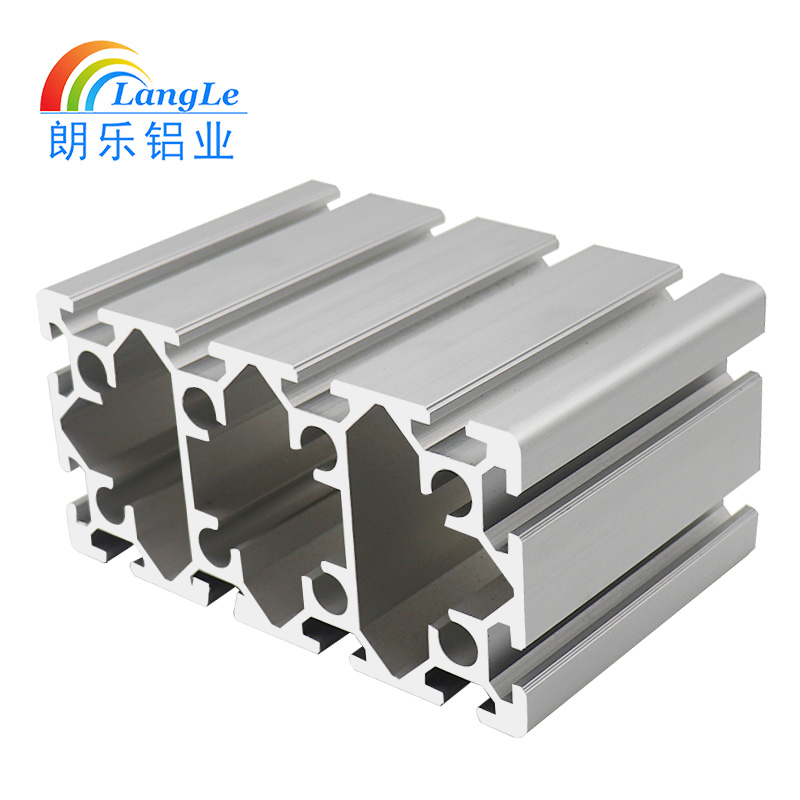
When planning an aluminum framing project, one of the first decisions is choosing the right profile series. Many buyers compare 20 series, 40 series, and 80 series aluminum extrusion because these profile families cover a wide range of applications, from light assembly frames to heavy-duty industrial structures.
At first glance, the choice may seem simple: smaller profiles for lighter jobs and larger profiles for heavier ones. But in practice, the right selection depends on far more than size alone. You also need to consider rigidity, span length, accessory compatibility, payload, installation environment, and budget.
This article explains the practical differences between 20 series, 40 series, and 80 series aluminum extrusion, so manufacturers, automation integrators, workshop planners, and OEM buyers can select the most suitable profile for each project.
What 20, 40, and 80 Series Usually Represent
In most modular aluminum framing systems, 20, 40, and 80 series usually refer to profile families organized around their nominal cross-section dimensions. For example, 20 series commonly includes profiles such as 2020, 2040, and 2060; 40 series often includes 4040 and 4080; and 80 series often includes 8080 and similar larger formats.
In practical terms, this means the series number usually signals the general size class of the profile family. As the section gets larger, the profile usually offers greater stiffness, higher load potential, and a wider application range. Published product data from major framing-system suppliers also shows that larger section families deliver significantly higher sectional area and moment of inertia than small profiles, which is why they are typically used for heavier structures and longer spans.
That said, the series number alone does not tell the full story. Within each family, you may still find light, standard, heavy, closed-face, reinforced, or application-specific variants, so final selection should always consider the exact profile shape rather than the series label alone.
Key Differences in Size, Rigidity, and Application Range
The most important difference between 20, 40, and 80 series profiles is how they perform structurally in real applications.
20 series
20 series profiles are compact and lightweight. They are easier to handle, easier to cut, and often ideal when the frame does not need to carry large loads or long unsupported spans.
40 series
40 series profiles are typically the best middle ground. They offer a much stronger frame than 20 series while remaining easier to assemble and more economical than very large profiles. In many industrial framing systems, 40 series is treated as the go-to option for general-purpose structural frames and guarding.
80 series
80 series profiles are designed for heavier structural needs. They are commonly selected when the frame must resist bending over longer spans, support heavy equipment, or serve as the main load-bearing structure in large industrial builds.
Comparison of 20, 40, and 80 Series Aluminum Extrusion
| Profile Series | Typical Profile Examples | Rigidity Level | Weight Level | Cost Level | Typical Use Range |
|---|
| 20 Series | 2020, 2040, 2060 | Low to medium | Low | Low | Light frames, displays, small guards, compact fixtures |
| 40 Series | 4040, 4080 | Medium to high | Medium | Medium | Workstations, machine frames, conveyors, guarding |
| 80 Series | 8080, 80160, similar large profiles | High | High | High | Heavy-duty bases, large frames, long spans, industrial platforms |
As a general rule, moving from 20 to 40 to 80 series increases section size, stiffness, and carrying capacity, but also increases material use, weight, and project cost.
Where 20 Series Works Best
20 series aluminum extrusion is usually the best choice when a project is light-duty, compact, or cost-sensitive.
Because the profile is relatively small, it works especially well in builds where:
the structure does not carry heavy dynamic loads
the span length is short
the frame needs to stay lightweight
the installation space is limited
visual neatness matters more than maximum structural strength
Typical 20 series applications include:
small machine guards
desktop or benchtop frames
light display structures
compact testing fixtures
simple shelves and partitions
electronics or instrument support frames
This matches how smaller-profile systems are commonly positioned in the market. For example, 80/20 describes its 20mm x 20mm metric 20 series profile as part of its smallest series and notes applications such as machine guards, work benches, panel mount racks, and displays.
20 series can be a very efficient option when you want to reduce cost and avoid overbuilding. However, it is usually not the best choice for long-span frames, large conveyors, or equipment bases exposed to higher loads and vibration.
When 40 Series Is a Better Balance
For many buyers, 40 series is the most practical balance between strength, flexibility, and cost.
Compared with 20 series, 40 series gives you:
better stiffness for medium spans
better resistance to frame deflection
more confidence for industrial use
broader compatibility with accessories and connectors
more room for panels, brackets, cable management, and guarding components
This is why 40 series is often used for:
machine enclosures
industrial workbenches
equipment frames
assembly workstations
automation structures
protective fences
conveyor supports
That positioning is consistent with broader framing-system guidance. Bosch Rexroth highlights aluminum structural framing for applications such as protective devices, safety fences, and ergonomic workstations, while mk North America describes Series 40 as its most flexible and versatile framing system and lists common uses such as guards, machine enclosures, workbenches, clean rooms, fume hoods, and carts.
If a buyer is unsure where to start, 40 series is often the safest default for general industrial framing projects. It is usually strong enough for most everyday builds without the extra cost and bulk of 80 series.
Which Projects Need 80 Series or Larger Profiles
80 series or larger profiles are typically needed when the structure must act as a serious load-bearing framework, not just a convenient assembly frame.
You should usually move up to 80 series when the project involves:
long unsupported spans
heavy mounted equipment
larger machine bases
large automation cells
industrial stairs and platforms
frames exposed to repeated loads or impact
structures where deflection control matters
The reason is straightforward: large profiles provide much higher stiffness and bending resistance. For example, representative published data shows a major jump in inertia and mass as you move into larger profile families; item’s Profile 8 80x80 is explicitly described as a robust universal construction profile, with technical data showing high section properties and a weight of 7.19 kg/m, while vendor documentation also stresses that profile moments of inertia and groove load-bearing capacity must be evaluated against the intended load.
In real projects, 80 series is often selected for:
heavy-duty machine frames
large conveyor systems
structural work platforms
industrial walkways and stairs
robot bases
floor-mounted support structures
high-load modular constructions
If the project needs to remain rigid over a larger footprint, 80 series is often the more reliable long-term choice.
Weight and Cost Comparison
Weight and cost usually rise with profile size, but the relationship is not only about raw material quantity. Larger profiles also affect:
20 series: lowest cost, easiest handling
20 series is generally the lightest and least expensive family. It is easier to move, easier to assemble, and more economical for small builds.
40 series: moderate cost, strong value
40 series usually offers the best cost-to-performance ratio for industrial frames. It costs more than 20 series, but the improvement in rigidity often justifies the price in real production environments.
80 series: highest cost, highest structural return
80 series uses more material and usually requires heavier connectors and stronger foundations. It is the most expensive option of the three, but for large or demanding structures, the higher cost may prevent later problems with flexing, instability, or redesign.
Choosing by Performance and Budget
| Priority | Best Choice in Most Cases | Why |
|---|
| Lowest budget | 20 Series | Minimizes material cost and keeps assembly simple |
| General-purpose industrial build | 40 Series | Best balance of rigidity, flexibility, and cost |
| Heavy-duty structural frame | 80 Series | Better stiffness and load capability for demanding projects |
| Compact equipment frame | 20 or 40 Series | Depends on span, payload, and accessory needs |
| Long-span frame or large machine base | 80 Series | Reduces deflection and improves structural stability |
| Workbench, guard, enclosure | 40 Series | Strong enough for most standard industrial applications |
The practical lesson is simple: do not choose the smallest profile that merely “works on paper.” Choose the profile that gives the project enough structural margin without creating unnecessary cost.
A Practical Guide for Choosing by Project Type
The easiest way to choose the right extrusion series is to start with the actual project type rather than the catalog number.
Choose 20 series when:
the frame is small and lightly loaded
the project is a compact guard, rack, or display
weight reduction matters
budget is tight
the structure is more functional than heavily structural
Choose 40 series when:
the project is a workstation, enclosure, or automation frame
the frame needs good rigidity without becoming oversized
the structure supports panels, accessories, or guarding components
you want the most versatile all-around profile family
the project may need future modification or expansion
Choose 80 series when:
the structure carries heavy equipment
span length increases frame deflection risk
the frame must act as a machine base or large support structure
long-term rigidity is more important than minimizing material
the installation environment is industrial and demanding
A practical buying approach is to ask these five questions:
How much load will the frame carry?
How long are the unsupported spans?
Will vibration, impact, or repeated loading occur?
How important are low weight and low cost?
Will the structure need future upgrades, guarding, or accessories?
If the answers point toward light-duty use, 20 series may be enough. If the project is a typical industrial frame, 40 series is often ideal. If the structure becomes large, heavily loaded, or highly rigid by requirement, 80 series is usually the better investment.
Conclusion
20 series, 40 series, and 80 series aluminum extrusion each have a clear role in modular framing projects.
20 series is best for lightweight, compact, and budget-friendly structures.
40 series is often the best overall balance for industrial workstations, guards, machine enclosures, and general framing.
80 series is the right choice for large, heavy-duty, and long-span structural builds where rigidity matters most.
For most buyers, the smartest decision is not to ask which series is “best” in general, but which series is best for the actual load, span, application, and budget of the project. When selected correctly, the right aluminum extrusion profile improves both assembly efficiency and long-term structural reliability.
Need help choosing the right aluminum extrusion series for your project?
Whether you need a lightweight 20 series profile, a versatile 40 series framing solution, or a heavy-duty 80 series structure, our team can help you compare sizes, accessories, and application requirements. Contact us today for technical support, profile recommendations, or a custom aluminum extrusion solution.
FAQs
1. What do 20 series, 40 series, and 80 series aluminum extrusion mean?
They usually refer to profile families organized by nominal cross-section size. For example, 20 series often includes 2020 and 2040 profiles, while 40 series includes 4040 and 4080, and 80 series includes 8080 and other larger structural profiles.
2. Is 20 series aluminum extrusion strong enough for industrial use?
Yes, for light-duty industrial use. It works well for compact frames, displays, small guards, and light fixtures, but it is usually not the best option for long spans or heavy loads.
3. Why is 40 series so commonly used?
Because it offers a strong balance of rigidity, flexibility, accessory compatibility, and cost. It is often the most practical choice for workbenches, machine enclosures, guarding, and medium-duty equipment frames.
4. When should I use 80 series aluminum extrusion?
You should consider 80 series when the project requires higher stiffness, heavier load support, better resistance to deflection, or a larger structural frame such as a machine base, platform, or long-span support.
5. Is 80 series always better than 40 series?
Not always. 80 series is stronger, but it is also heavier and more expensive. For many standard industrial applications, 40 series provides enough strength at a better overall cost.
6. Which aluminum extrusion series is best for a workbench?
In many cases, 40 series is the best choice for a workbench because it provides a good mix of rigidity, assembly flexibility, and cost efficiency. Heavier-duty workbenches may require larger profiles.
7. How do I choose the right extrusion series for my project?
Start by evaluating load, span, environment, accessories, and budget. Then match the series to the project type: 20 for light-duty builds, 40 for general industrial frames, and 80 for heavy-duty structural applications.